New Birth Leave:
what changes on July 1, 2026

Effective July 1, 2026, a new additional birth leave will supplement the current provisions related to the arrival of a child. Designed to support parents in the early months following a birth or adoption, this new entitlement will give parents more time with their child and more flexibility in managing family life.
For the employers, this reform also raises several practical questions, especially regarding eligibility requirements, compensation, payroll processing, and DSN declaration.
In this analysis, Adrien Billaux, legal expert in social law at Primexis, breaks down the key measures of this reform and the issues employers need to be aware of.
Which employees will be eligible?
The additional birth leave will apply to the employees who have taken maternity leave, paternity leave, childcare leave, or adoption leave.
To be eligible, they must, in principle, have exhausted their entitlement to Social Security benefits for this type of leave.
However, this condition will not apply to employees who were unable to take their full leave due to the absence or interruption of their Social Security benefits.

What will the duration of the leave be?
Each parent will be eligible for leave lasting between one and two months. In total, both parents could therefore spend up to an additional four months with their child.
The leave can be requested all at once or in separate periods to give families more flexibility in organizing this time.
Please note: the duration of the additional leave will not be extended in the case of multiples.
By when must the leave be taken?
This leave must be taken no later than the last day of the ninth month following the birth or the arrival of the adopted child in the household.
If the maternity, paternity, or childcare leave is extended, particularly in the case of multiples or the child’s hospitalization, this deadline will be extended accordingly.
What is the process for the employee?
The employee must notify the employer before the start of the leave. When the additional leave immediately follows their maternity, paternity, or childcare leave, the employer must be notified at least two weeks prior to the start of the leave.
If the leave is taken at a later date, the employee must notify the employer at least one month before the desired start date. As long as the request is made within the timeframe stipulated by law, the employer cannot refuse the leave.
Will it be possible to return to work early?
The employee can request to return to work early in certain situations, particularly in the event of the death of the child or a signification reduction in household income.
The employee must notify the employer at least eight days before the return-to-work date by any means that provides a definite date for the request.
What compensation is provided during the leave?
The leave will be compensated by the CPAM (French Primary Health Insurance Fund), provided that the conditions for eligibility for Social Security daily benefits are met.
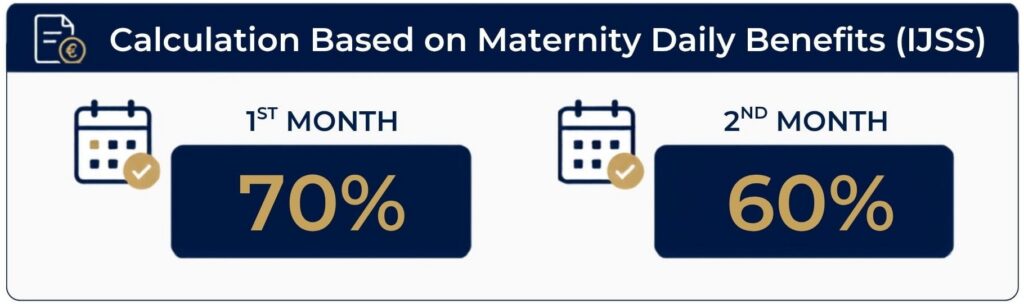
Compensation will be calculated based on the maternity daily benefits (IJSS) rate, with a 70% coefficient applied for the first month and 60% for the second month.
In principle, no additional salary will be paid by the employer in accordance with the French Labor Code.
However, a company or branch collective agreement may provide for additional compensation, net of the daily benefits (IJSS) paid by the CPAM.
What are the impacts on payroll?
The employer must issue a maternity pay certificate so that the employee can receive benefits from the CPAM. The leave declaration will be processed in two stages.
Until September 30, 2026, the leave must be declared on the DSN within 5 days following the start of the leave. This declaration must be supplemented by an Excel file available on net-entreprises and submitted to the relevant organizations.
Effective October 1, 2026, the declaration will be made exclusively via the DSN.
What are the impacts on employees’ rights?
The additional birth leave will be treated as actual working time for the purpose of determining rights related to seniority.
Employees will also retain the benefits accrued before going on leave and will be protected against dismissal.
However, as the text currently stands, this leave will not be counted toward the accrual of paid leave, nor will it be included in the actual time worked for the purpose of distributing profit-sharing and performance-based bonuses.
From our legal expert’s point of view
Under European law, maternity leave is considered actual working time for purpose of accruing paid leave.
At this point, no ruling has yet been issued regarding this new additional birth leave. Changes in interpretation cannot therefore be entirely ruled out, as we have recently seen in other matters related to the accrual of paid leave.
Companies wanting to ensure their practice are compliant can already anticipate this potential development by treating the additional birth leave as actual working time for the accrual of paid leave.
________________
How to prepare for this reform?
Even if the reform is scheduled to take effect on July 1, 2026, companies would be well advised to start preparing for it now. The main areas to anticipate include informing employees, updating internal procedures, coordinating with current collective agreements, payroll processing, and reporting requirements in the DSN.
Primexis’ Payroll & HR Advisory team supports companies with implementing this new leave and adapting their internal practices.
For any questions about this reform, please contact our team.